When is an apology not an apology?
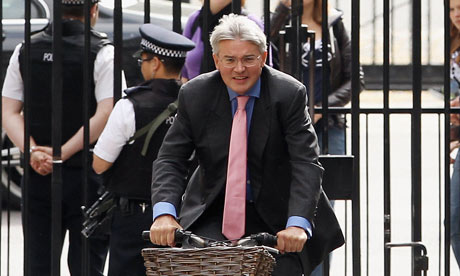
It’s now, or so it seems. Last time I wrote about this I heralded Andrew Mitchell (Conservative Chief Whip) as a man showing the noble art of repentance. You may, albeit dimly, recall how he cycled up to Downing Street to do his day job, was told where to go by a policeman and promptly flew off the handle. Over the next few hours he dutifully smothered himself with apologies and statements of regret. I now confess to an uneasy feeling while writing that original piece [1] because a particular thought had taken on a life of its own in my head. It trundled around my brain like an unwelcome visitor. It called out “don’t be too definite about Mitchell’s repentance Ian! Guard your words! This is politics, that rarefied parallel universe where things change like the wind! something else might come out!”
It did.
 [2]
[2]
It seems that Mitchell turned up for work the next day and tried to pull the same stunt again, attempting to go through the gate verboten for cyclists (here [3]). Oh Andrew, what a classic case you are! You’ve just taught me (as I probably needed reminding) about the difference between remorse and repentance. It’s huge. Remorse produces statements of regret and feelings of “Doh, I shouldn’t have done that. What will people think of me?” but doesn’t fundamentally change things. Its big brother repentance, however, changes things completely. Remorse is all in the mind and the mouth, whereas repentance is in the heart and the hands – and in this case could have been in the pedals.
This universal principle works its way out from the school playground to the cabinet office. Young children can learn (hopefully from their parents and the example set by people in a church) that saying sorry may be the hardest word, but doing sorry is the noblest action. Principles like this are learned in the playground but need to be practiced in the board room.
Too often we forget that repentance requires courage. It is not for the faint-hearted or the people-pleaser, it’s for the man or woman of principle who is not afraid to let their mistakes be a driving force towards reformed action. Christ came to bring forgiveness to us when we genuinely repent. Paul (along with a host of other Biblical writers) urged his church members in Colossae not just to change their thinking, but to change their actions
You must rid yourselves of all such things as these: anger, rage, malice, slander, and filthy language from your lips. Don’t lie to each other, since you have taken off your old self with its practices and have put on the new self, which is being renewed in knowledge in the image of its Creator. (Colossians 3:8-10)
OK, so last time I got it wrong.
I apologise!
(unless there is more to the story that we have yet to hear)
 [4]
[4]